The Challenge

Reducing Energy Consumption While Enhancing Cooling Capacity and System Stability
In the summer of 2024, Energy Recovery conducted a rigorous measurement and validation (M&V) program to assess the performance gains achieved by incorporating the PX G1300 into diverse CO2 refrigeration system designs and load sizes.
PX G1300 Benefits
Lower energy consumption
Up to 30% peak COP lift* and 15% annual energy savings
Safeguard against heatwaves
Increase design temperature by as much as 6°C/11°F*
Reduce OPEX
Minimize or eliminate water usage from adiabatic gas coolers
Support sustainability
Reduce carbon footprint
Energy Savings

The PX G1300 pressure exchanger is a versatile solution to simplify energy efficiency for CO2 refrigeration. It can be seamlessly incorporated into new systems or retrofitted onto existing racks with the compact, predesigned PX Energy Optimizer module. The PX G1300 can deliver as much as 30% peak COP lift with projected annual energy savings of up to 15% or more.*
The biggest advantage of the PX G1300 installation is that we can save on our energy bill. Since our cooling is our biggest energy consumer, this setup allows us to save up to 15% annually.
Tom De Witte, Managing Director at Delhaize in Waregem, Belgium
Increased Capacity
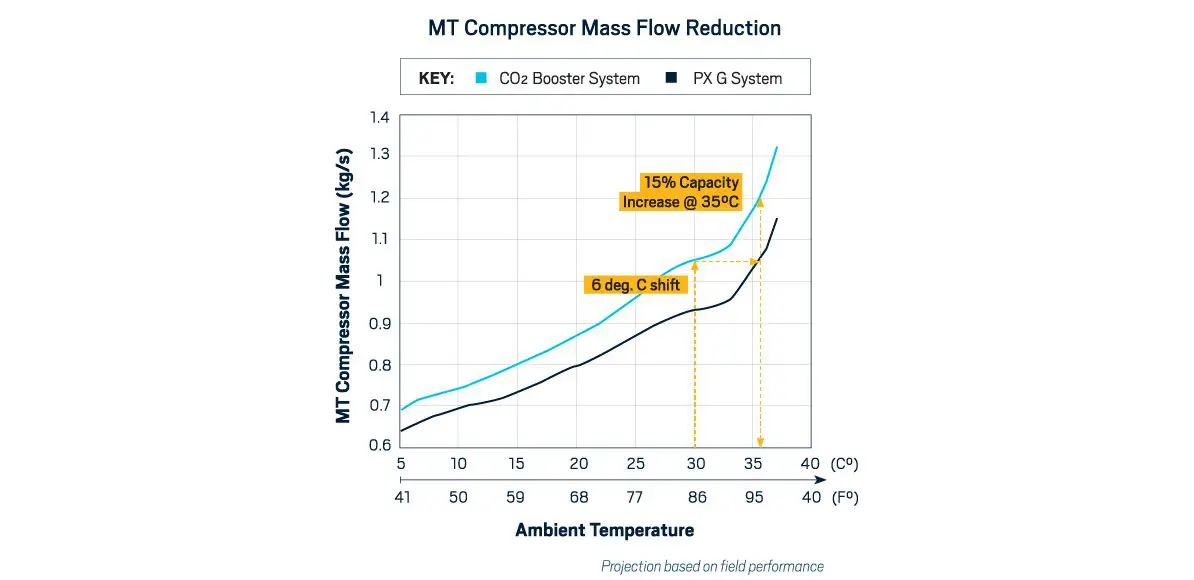
The PX G1300 reduces flash gas in CO2 systems, improving energy efficiency and increasing system capacity. In normal system conditions, it saves energy, decreases dependence on water spray systems, and provides operational flexibility. Under high temperature stress, the PX G1300’s reduction in flash gas offers extra capacity and high temperature rack stability to protect against high-pressure discharge failure and associated downtime.
In a 150 kW system, incorporating the PX G1300 can increase system capacity by up to 15% at 35°C/95°F*, as measured by a reduction in flash gas through the MT Compressor, or result in a 6°C/11°F rise in design temperature to safeguard against heat waves.
* Disclaimer: Actual results may vary based on multiple factors including system architecture, cost of electricity, ambient temperature, square footage and size of facility, variable loading of the system, time of day, and geographic location. Findings based on customer testimonials and Energy Recovery’s laboratory and field results. Energy Recovery accepts no responsibility for possible errors in catalogues, brochures and other product material, and reliance on data is at your own risk. All trademarks in this material are the property of the respective companies.