The Challenge

Addressing Water Scarcity with Energy-Efficient SWRO
According to the World Resources Institute (WRI), Chile is the most water-stressed country in the world. The Atacama Desert is one such water-scarce region in northern Chile that needed a reliable and efficient potable water source for its population. The Atacama Desalination Plant arose around this need, the largest desalination plant for human consumption in Chile and the first of its kind financed entirely by the state through the company ECONSSA Chile S.A. A crucial project for the region, the Atacama Desalination Plant ensures drinking water supply in an area that lacks natural aquifers for self-sufficiency. The plant was commissioned in 2021, having a starting capacity of 38,880 m3/day to guarantee drinking water for the Atacama region, with plans to expand and run primarily on renewables. Lowering the specific energy consumption (SEC) by a significant margin was a critical challenge for the plant to reduce the number of solar panels and wind turbines needed, as well as to address the challenge of storing energy during unfavorable conditions, such as nighttime.
Location
Caldera, Atacama
Estimated annual energy savings
29.1 GWh
OEM
GS INIMA
Plant name
Atacama Desalination Plant
Plan capacity
38,880 m³/day
Cost savings
$3,201,000 USD annually
Optimizing Energy Consumption using the PX Q300
In 2021, the joint venture comprised of the companies GS Inima Environment SAU and Constructora Claro Vicuña Valenzuela led the construction of one of the largest desalination plants in the region. Its large capacity required energy optimization to reduce operational costs.GS Inima partnered with Energy Recovery to install its proven and reliable pressure exchangers, one of the solutions to lower operational energy costs and increase efficiency.
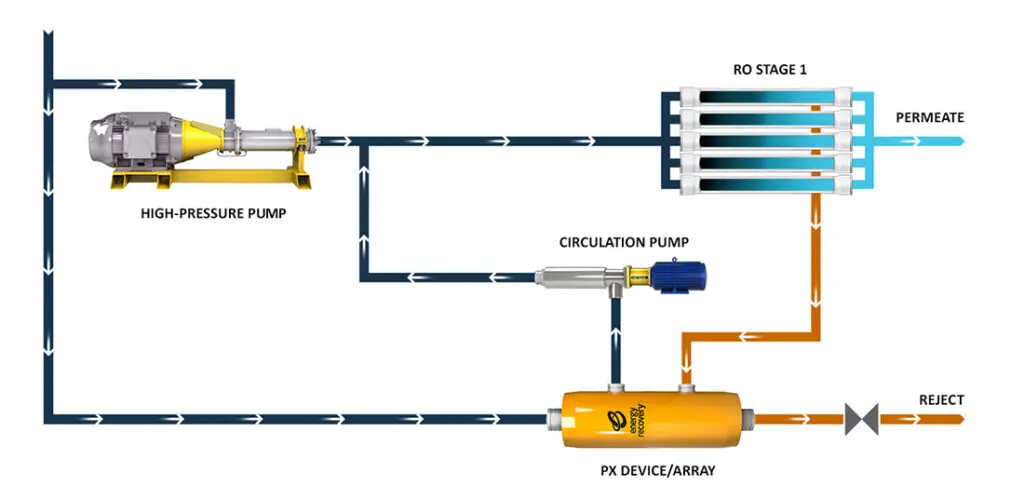
The designers of the Atacama Desalination Plant were committed to reducing their specific energy consumption from the outset. To achieve a reduction in power consumption, one of the solutions considered by the consortium was to integrate 10 of Energy Recovery’s PX Q300 devices in each of the production lines. The PX Q300 is an isobaric pressure exchanger device from Energy Recovery’s PX Q series line that recovers energy from the reject stream at high efficiency. It works by transferring energy from the high-pressure reject stream to the incoming low-pressure feed stream, reducing the flow through the high-pressure pump.
Atacama Desalination Plant:
- Low specific energy consumption of 2.8 kWh/m3
- 7 ultrafiltration modules
- 3 reverse osmosis trains, each with 10 PX Q300s
- Quality drinking water for 210,000 individuals across 4 communities
The PX is a reliable technology that requires low maintenance costs and maintains its efficiency over time. Today, we have evidence that the specific energy consumption of the plant maintains the same values since its start-up. When energy is saved, it reduces the plant’s operational costs and is reflected in a lower rate for our users who are paying for the operation at the end of the day.
Carlos Goitia, Nueva Atacama Desalination Manager
Lowered Specific Energy Consumption and Operational Costs
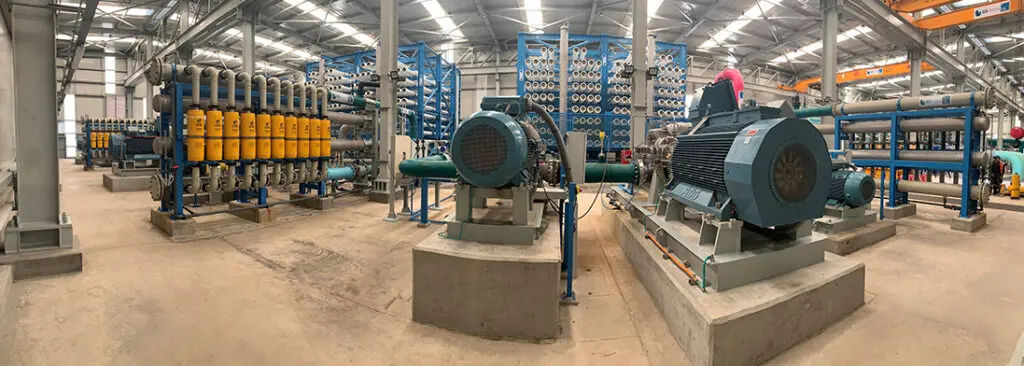
Incorporating the PX Q300 for the Atacama Desalination Plant was a key factor in achieving a low specific energy consumption of 2.8 kWh/m3, including pretreatment and intake, and even reaching levels as low as 2.6 kWh/m3 during performance tests for the entire facility. Compared to a typical SWRO plant with SEC values of 3.5 – 4.5 kWh/m3, this is one of the lowest rates for any operating desalination plant in the country, which is critical due to its use of renewable energy sources, mainly from solar and wind energy. The plant reduced yearly energy consumption by 29.1 GWh, cutting operational costs by an estimated $3.2 million USD annually. Using PX® Pressure Exchanger® technology, the Atacama Desalination Plant has been providing clean water to address water scarcity in the region since 2021, with a low carbon footprint.
The plant’s total capacity is 38,880 m3/day of product water, which can be delivered with the highest efficiency due to Energy Recovery’s PX Q300 energy recovery devices.