The Challenge

Tackling Degrading Raw Water Quality
A brackish water reverse osmosis (BWRO) facility in the City of North Port, Florida, needed a flexible solution to maintain efficient operation and combat degrading raw water quality in nearby wells. Capable of producing up to 2.0 MGD (7,500 m3/day) of potable water, the facility treats raw water from local wells with the total dissolved solids (TDS) level projected to increase to 13,000 mg/L. With salinity rising by as much as 370% in the first ten years of operations, the facility required a flexible solution to operate across varying TDS, flow, and pressure levels to save energy in the system.
Location
North Port, Florida, USA
Project
North Port, Florida’s Southwest Water Treatment Plant
Facility Capacity
Up to 2 MGD (7,500 m3/day)
Est. Energy Savings
1.7 kWh/ KGal (0.45 kWh/m3)*
Est. Cost Savings
$23,000 – $200,000+ Annually**
The Solution
BWRO Facility Uses Low-Pressure PX® Pressure Exchanger®
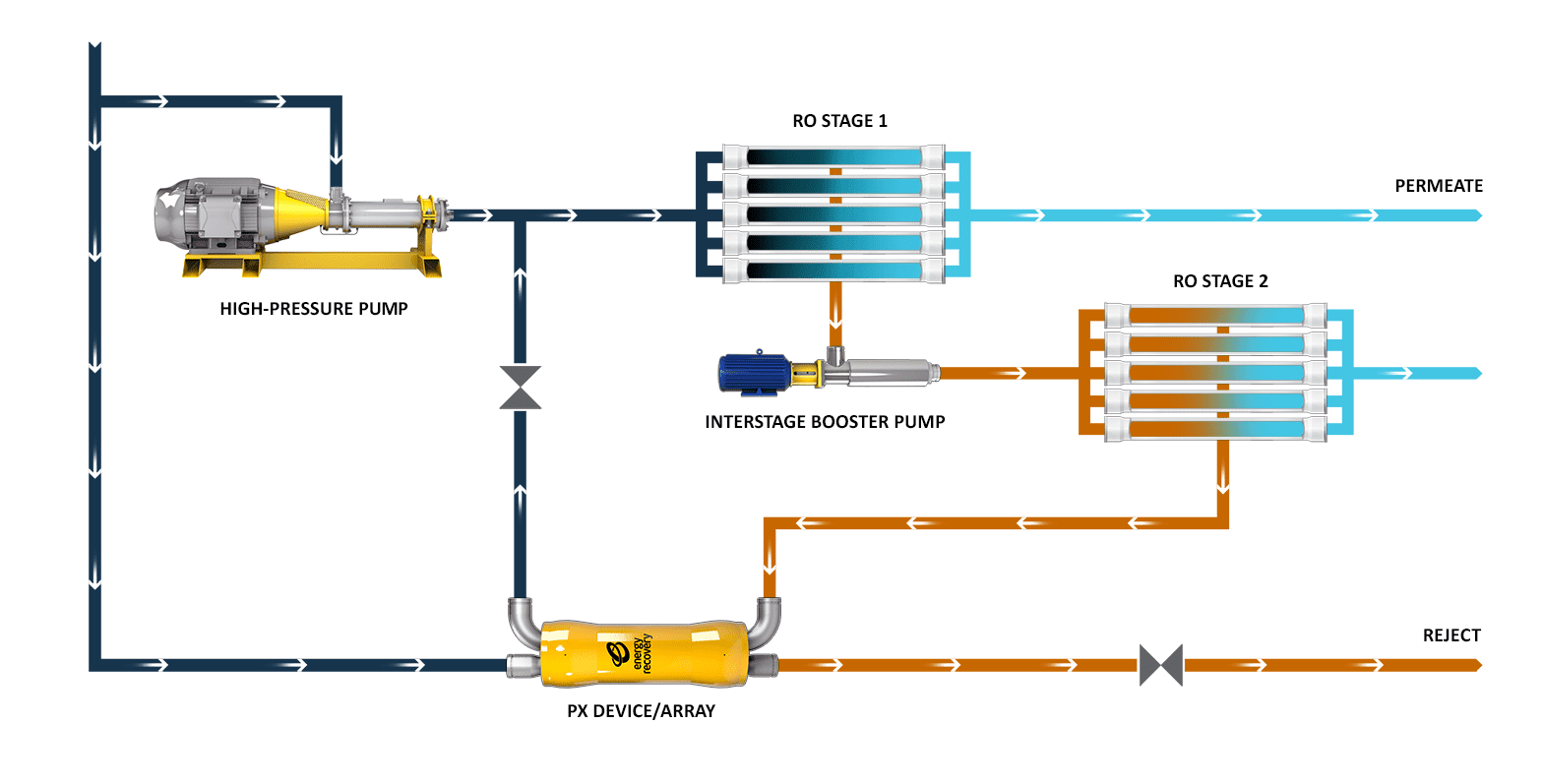
Design experts from Kimley-Horn and Associates, Inc., a premier planning and design consulting firm, sought to reduce energy costs in anticipation of varying operating conditions by collaborating with Energy Recovery, Inc. to incorporate the PX® Pressure Exchanger®. The designers chose to integrate one low-pressure PX (LP PX) in two reverse osmosis (RO) skids to offset the rise in energy consumption brought on by the anticipated increase in water production and salinity.

The low-pressure PX offered a flexible solution for varying conditions, such as flow and pressure levels, capable of providing efficiencies of up to 95% despite changes in TDS and temperature. Typically installed at the brine stream of the final RO stage, the LP PX transfers hydraulic energy from the brine to the raw feedwater stream, reducing the work on the high-pressure pump and saving energy.
LP PX Integration Benefits
- Reduced the membrane feed pump flow by 20%.
- An estimated reduction in horsepower of at least 33 HP.
- Approximately $95,000 in reduced capital expenditure for the pump motor and other components.
- Stable efficiency maintained across variations in flow and pressure (5.5 – 27.6 bar; 80 – 400 psi).
LP PX Maintains Efficient with Varying Flow and Pressure Levels

The Result
The PX Maintains Efficiency with Varying Flow Rates and Pressures
The facility streamlined its design to utilize the PX and maximize operational savings over the device’s 25-year design life. A year after commissioning, results demonstrated a high average efficiency of the LP PX over two months of continuous operation, with low starting salinities and constant flow. Based on current production and salinity levels, the facility was estimated to save 0.44 kWh/m3, which translates into an annual savings of $23,000.** And as the salinity and production increase in the future, those savings could compound significantly over time to as much as 1.1 kWh/m3 and over $211,000 per year.**
*Energy savings projected to reach up to 4.2 kWh/kGal (1.1 kWh/m3) under future conditions
**Actual results may vary; cost savings based on the price of electricity in 2022 are projected to reach $211,000/year under future conditions