The Challenge
Our customer, a leading public salt chemical company, needed to drastically increase soda production to meet growing regional needs from manufacturers of solar panels and lithium batteries for electric vehicles. The company could no longer rely on its traditional salt lake dry land production method of extracting salts to meet the Na2CO3 production spike in demand. Soda ash (sodium carbonate) is a critical ingredient in the production of high-purity glass for solar panels and is used in refining lithium for EV batteries, making it essential to the green energy supply chain. As global demand for clean energy technologies accelerates, scaling up soda production has become a strategic priority.
The production team sought to develop a novel nanofiltration design to concentrate brine for soda production, but they needed to ensure that the process could be sustainable, both in terms of operational reliability and energy efficiency.
Location
East China
Project
A Soda Plant
Customer
A Leading Soda Company
Annual Savings
$2,000,000 USD
Payback Period
<1.5 years
The Solution
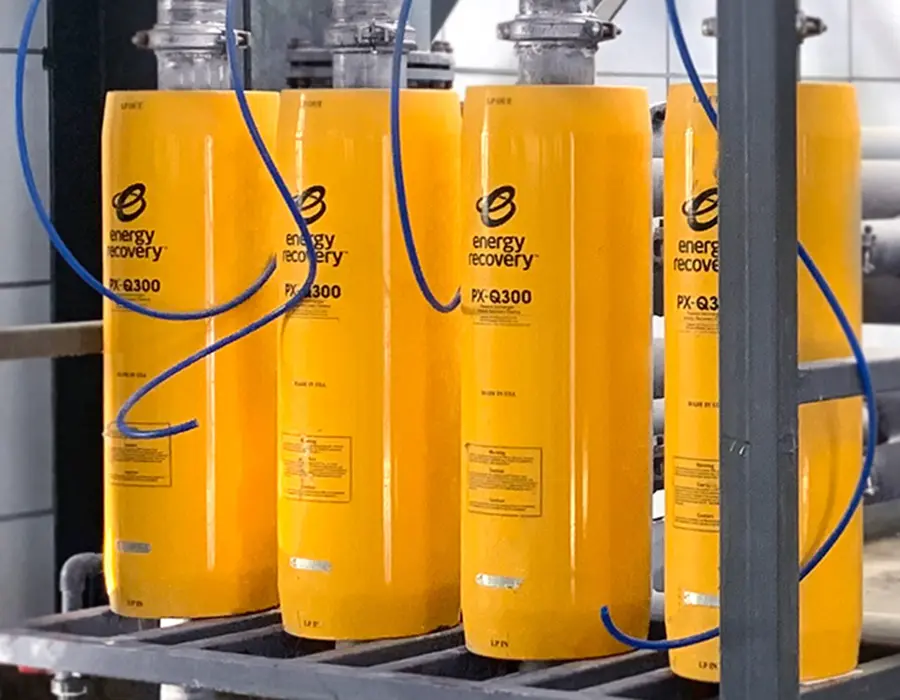
The company implemented multiple PX® Pressure Exchanger® (PX) energy recovery devices into its new system in two phases:
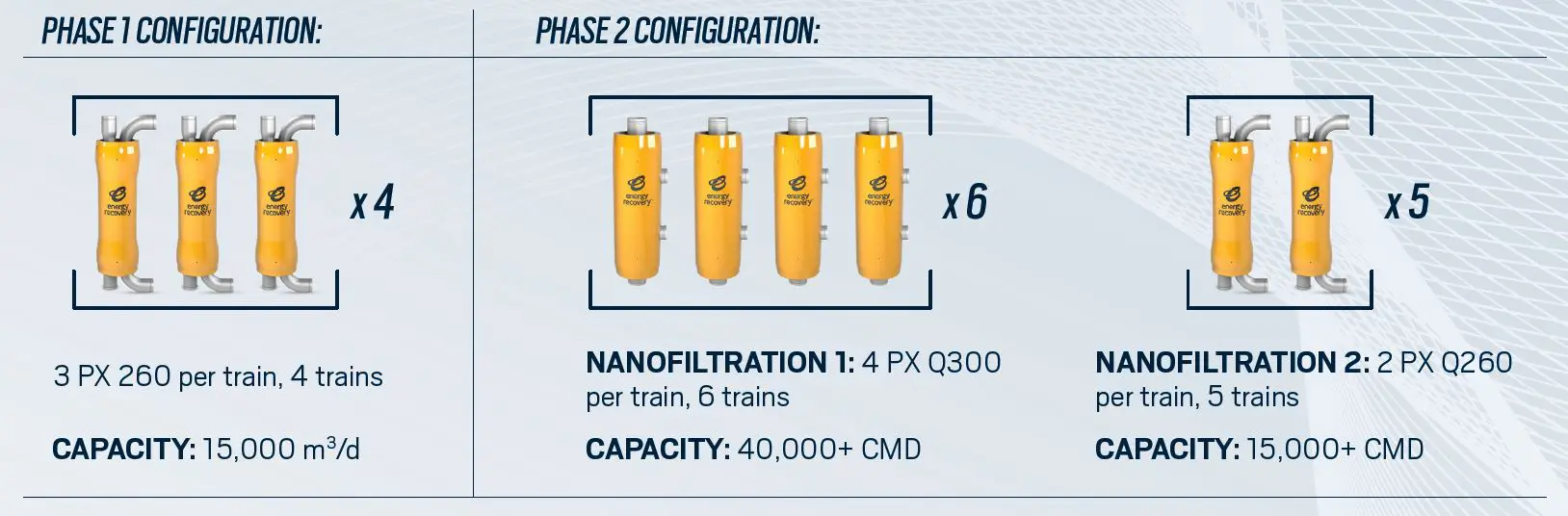
This allowed the company to use a nanofiltration membrane to produce highly concentrated salt for sodium carbonate production all while significantly reducing operational expenditures. With its state-of-the-art ceramic alumina material, the PX performs exceptionally in high-pressure and corrosive environments, and can reduce energy consumption in the nanofiltration process by more than 40%.
The PX also enables the company to effectively extract valuable materials from the brine, such as bromine, calcium, magnesium, potassium, and sodium sulfate. PX technology’s proven reliability and industry-leading energy savings directly support our customer’s goals of ensuring long-term operational reliability and maximizing energy efficiency—critical factors as the company scales production to meet rising demand.
With the utilization of PX technology and the nanofiltration process in the brine concentration project, the facility can treat 70,000 cubic meters of brine water per day with energy consumption reduced by more than 40%. It also comprehensively utilizes valuable resources such as sodium chloride, bromine, calcium, magnesium, potassium, and sulfate in the brine to achieve a ‘double harvest of fresh water and brine,’ which has significant economic and social benefits.
Customer Project Team
The Result
By integrating PX energy recovery devices with nanofiltration in these two phases, our customer achieved substantial operational and economic benefits. The system refines over 70,000 cubic meters of brine daily, producing approximately 1 million tons of raw soda ash annually within a compact 10,000-square-meter plant—output that would traditionally require 60 square kilometers of land. This shift not only accelerated the production cycle by over 95% but also delivers more than $2 million USD in annual energy cost savings. The closed-loop water system further reduces freshwater consumption and associated costs, reinforcing our customer’s commitment to efficiency and sustainability.
The soda company’s adoption of nanofiltration with PX technology has redefined what’s possible in brine concentration and soda ash production. By combining cutting-edge energy efficiency with resource recovery, the company is able to meet the rising demand for critical raw materials and has done so in a way that is both economically and environmentally sustainable. This project serves as a model for scalable, high-impact innovation in the chemical and water treatment industries.
Project Results
Phase 1:
- Annual Savings: $645,120 USD (based on 350 days)
- Payback Period: < 1.5 years
Phase 2:
- Annual Savings: $1,541,400 (based on 350 days)
- Payback Period: < 1.5 years
Power Cost Basis: $0.10 USD/kWh