The Challenge

- The nearby Bandi River is polluted due to the discharge of industrial effluents and sewage disposal
- Polluted water flowing in the Bandi River is a constant threat to the health of villagers and to agriculture
- Current Common Effluent Treatment Plants (CETPs) were not achieving zero liquid discharge (ZLD) and effluents were still being discharged into the river
Location
Pali, Rajasthan, India
Project
PALI CETP (Textile)
Facility Capacity
12 MLD (3.17 MGD)
Est. Cost Savings
$483,000 USD per year
Customer
Aldee Water Pvt. Ltd.
Est. Energy Savings
13,234 kWh/day
Payback Period
12-18 Months
The Solution

The Pali Common Effluent Treatment Plant in Pali, Rajasthan, India supports 215 factories located in the surrounding Punayata Industrial Area. All the equipment in the plant is supplied by Aldee Water Pvt. Ltd. Advanced reverse osmosis water treatment was adopted to significantly reduce the stream volume being sent to the thermal system, reducing both CAPEX and OPEX of the thermal system. With added nanofiltration processes in place to separate salt, the high purity salt could then be recycled and sold.
To achieve more efficiency and cost savings, Detox Group and Pali CETP partnered with Energy Recovery, Inc. to install a suite of energy recovery devices, including both turbochargers and pressure exchangers, bringing higher uptime and availability to the whole system.
The plant now utilizes the following Energy Recovery products: AT Turbocharger, PX Q300s, PX Q220s, AquaBold high-pressure pump, and HP and VPXP circulation pumps.
The goal was to achieve high recovery rates in the membrane trains to minimize the brine flow into an evaporator to meet minimal or zero liquid discharge regulations. This required multiple reverse osmosis systems in conjunction with nanofiltration.
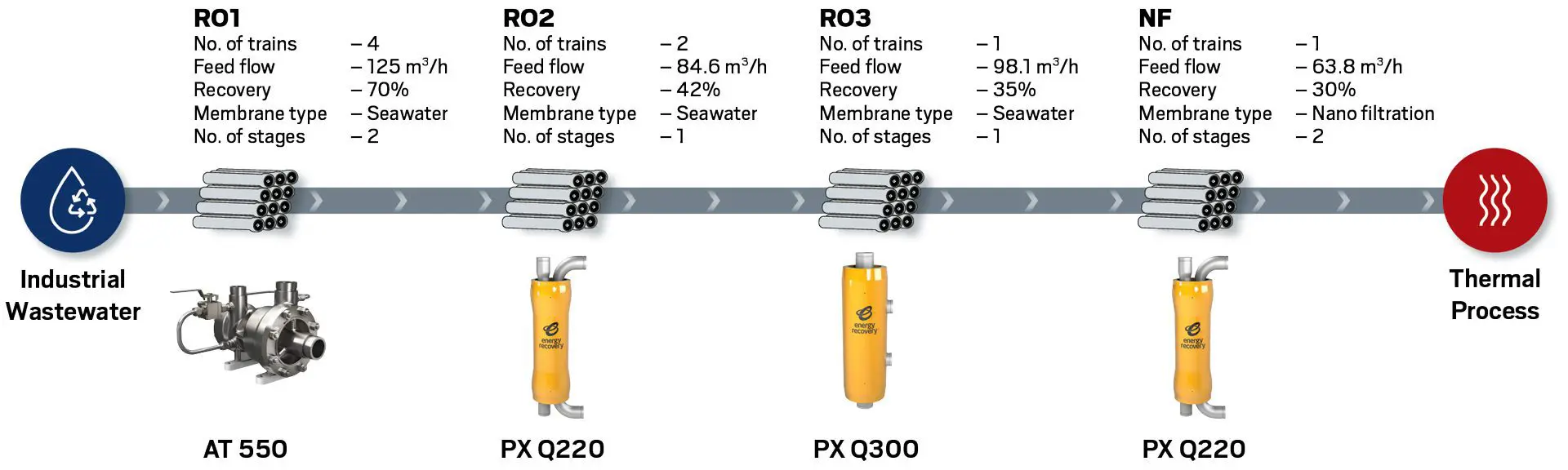
Energy Recovery’s solutions accommodate wide flow and pressure operating ranges
The textile waste stream parameters from 215 textile manufacturing businesses can pose a challenge, leading to wide flow and pressure operating ranges for the RO process. The challenge was met with a full complement of Energy Recovery products proven to perform in these demanding conditions, achieving maximum plant savings and energy efficiency.
The PX devices with a suite of companion pumps provided operational flexibility and was the ideal solution for the Pali CETP plant.
As the proud developer of the Pali CETP project, we are very pleased with our decision to use Energy Recovery PX® Pressure Exchanger® technology, turbocharger technology and pump solutions in our water plant.
V. Rami Reddy, PALI CETP Project, Project Execution Head
The Result
Energy Recovery engineers worked with the OEM and completed the entire commissioning process in one week
- RO1 with four trains of AT-550 turbochargers
- RO2 with two trains of PX Q220 operating at an efficiency greater than 95%, AquaBold™ high-pressure multi-stage pumps, and additional booster pumps
- RO3 with one PX Q300 train operating at an efficiency greater than 95%, an AquaBold™ high-pressure multi-stage pump, and a booster pump
- The nanofiltration system with one PX Q220 operating at an efficiency greater than 95%
The system is expected to realize a total of 13,234 kWh in energy savings daily. The payback for the combined energy recovery equipment and pumping solution is projected to be 12-18 months, even at a reduced feed of total dissolved solids (TDS). As the plant continues to increase TDS concentrations and system pressures, the efficiency of these ERDs is expected to increase, recovering even more energy and increasing savings for the plant.
By utilizing Energy Recovery’s various solutions in the system, the facility is achieving savings in operating expenses estimated at $483,000 USD per year. The facility was also able to reduce investment in the thermal system. Additionally, the treated freshwater has been sold back to 215 plants, creating significant revenue. Finally, the efforts prevented further pollution of the Bandi River, helping the environment by sending the undissolved solids into an evaporation pond.