The Challenge
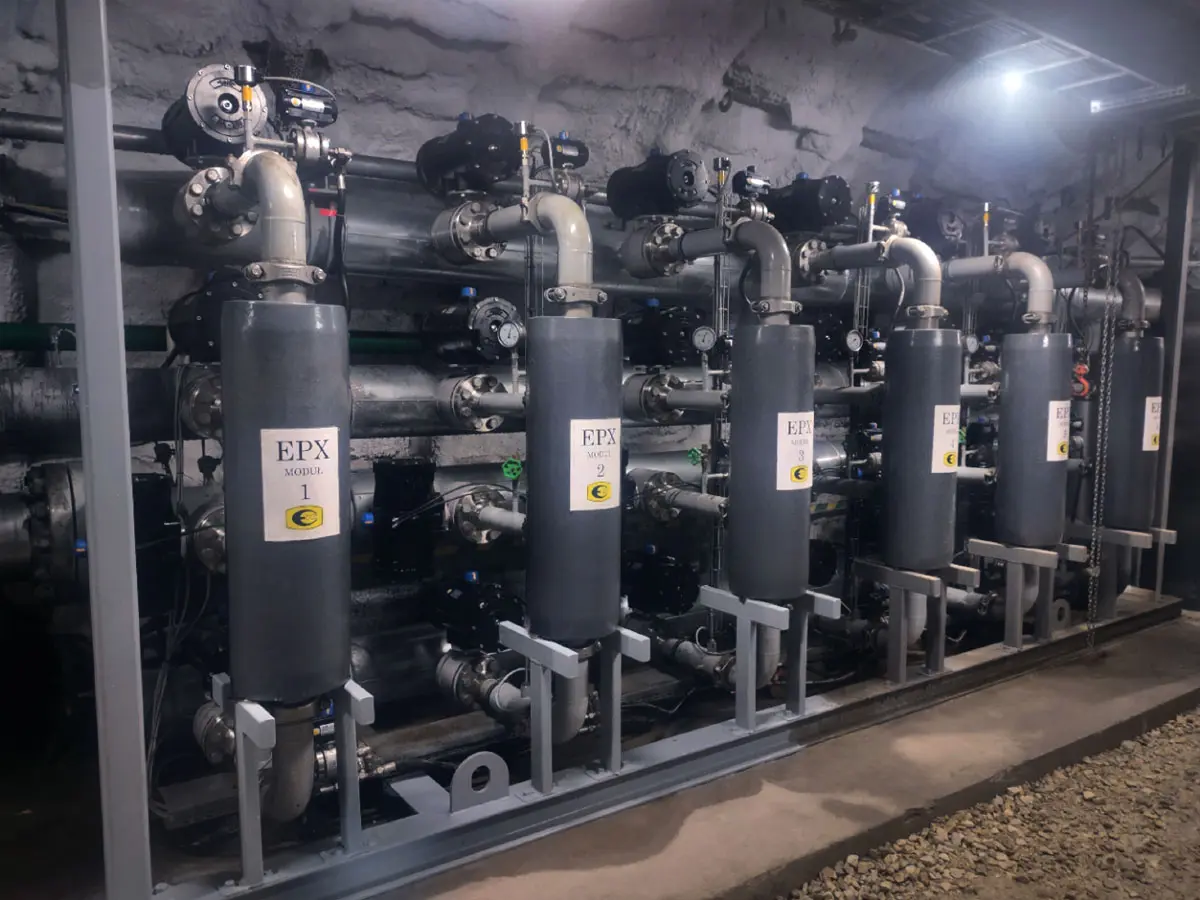
Units were finished with an antistatic coating to support ATEX Group I mining requirements
Cooling and pumping are among the largest energy consumers in deep mining, especially where access to ore demands long vertical drops and extended water loops. For a new 7 MW underground bulk air cooling (UBAC) system in Poland, mine operator Polska Grupa Górnicza and system integrator Elektrometal sought to reduce pump power, avoid extra excavation, and keep maintenance simple while ensuring a low temperature increase of the cooling medium (maintaining at 0.2°C).
The incumbent multi-vessel energy recovery approach used in similar mining operations is bulky and valve-intensive, often forcing tunnel height extensions and adding operational complexity. The project team needed a compact, reliable energy recovery device that would fit standard headings, provide operational flexibility, and deliver a fast payback.
Location
Katowice, Poland
Project
7 MW UBAC system
Energy Savings
9 GWh per year
Cost Savings
$1.3M per year
The Solution
Elektrometal selected Energy Recovery’s PX® Pressure Exchanger® for the chilled-water circuit, installing one modular train of six Pressure Exchanger units rated to 120 bar. The train transfers pressure from the high-pressure chilled-water stream to the low-pressure warm-water return, capturing energy that would otherwise be lost across a throttling valve.

Handling approximately 300 m3/h of refrigerated water, the pressure exchanger reduces the power required to pump water back to surface equipment while preserving target temperatures underground. Its simple rotor design has few moving parts and no complex valve sequencing or electronic controls, which translates to high availability and zero routine maintenance. A compact footprint eases installation in constrained drifts, and the modular architecture provides operational flexibility since units can be taken offline to match lower seasonal loads while the system continues running.
Commissioning in March 2025 was seamless, with the PX train installed within the standard tunnel opening and integrated into the existing control philosophy.

The Pressure Exchanger solution has delivered consistent, high performance while reducing cooling losses and freeing our technicians from frequent inspections. Its compact footprint saved valuable underground space, and the modular train gives us flexibility as the mine evolves.
Piotr Cieślar, Director of Sales, Elektrometal
The Result
The facility is realizing meaningful reductions in pumping energy and operating cost while improving system controllability and space utilization underground.
- Energy savings: 9 GWh per year of electricity avoided*
- Cost savings: $1.3M per year at an electricity rate of $0.15/kWh*
- 1 MW pump avoided with the Pressure Exchanger
Beyond the numbers, the PX train’s compact design eliminated the need for additional excavation and reduced the burden on maintenance crews compared with larger multi-vessel alternatives.
*Energy and cost savings numbers are closely approximated.
Why It Matters
Recovering pressure energy inside the UBAC circuit offers a practical lever to cut operating costs without compromising safety or production. Compared with bulkier multi-vessel systems, the PX train provides a smaller footprint, fewer wear components, and straightforward operation that helps operators de-risk projects and control lifecycle cost.
Looking Ahead
Containerized SWRO is one of the fastest-growing formats in municipal and industrial desalination, and Oman is one of the most active markets for it. The Dibba project shows what’s possible when high-efficiency energy recovery is designed in from the start: a small plant that produces water at large-plant economics, in a footprint that ships on a flatbed.
To explore PX solutions for mine cooling, contact our team at sales@energyrecovery.com.