Introduction
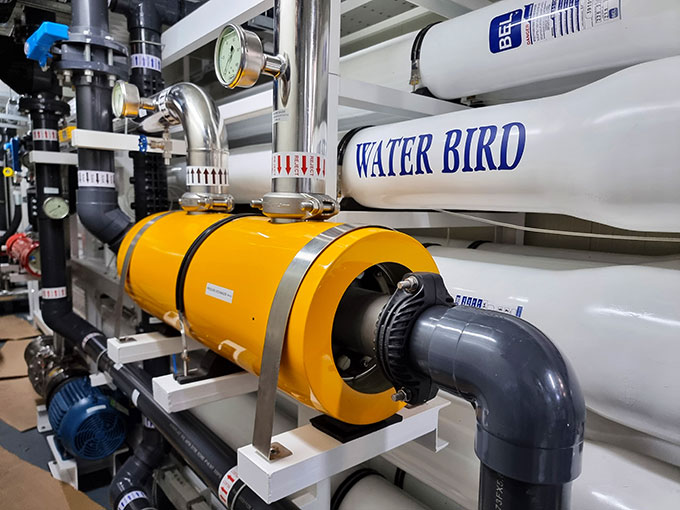
Oman meets roughly 86% of its potable water demand through desalination, and Musandam, the country’s exclave on the Gulf of Oman, depends almost entirely on coastal SWRO to keep taps running. When Nama Water Services and Oman National Engineering & Investment Co.
(ONEIC) needed to add 1,200 m³/day of potable capacity in Dibba, the project had to fit inside a containerized footprint, deliver utility-grade reliability, and run on as few kilowatt-hours per cubic meter as possible. Water Bird Water Treatment Chemicals designed the system, and Energy Recovery’s PX Q400 sits at the heart of it.
Location
Dibba, Musandam Governorate, Oman
OEM/System Integrator
Water Bird Water Treatment Chemicals LLC
Plant Capacity
1,200 m³/day SWRO (50 m³/h permeate)
SEC
2.35 kWh/m³
Energy Reduction vs. No-ERD Baseline
55%
Energy Savings
1,248,300 kWh/year
Estimated Cost Savings
$100,000 USD/year
The Challenge
Big Capacity, Container-Sized Constraints
Containerized SWRO is a demanding format. Every component, from pumps and membranes to instrumentation and the energy recovery device (ERD), has to fit inside a fixed shell, share its footprint with piping and electrical, and still deliver the energy efficiency of a much larger plant. There’s no slack on either dimension. Add Musandam’s geography, where every cubic meter of water the governorate consumes either comes from the sea or arrives by truck, and reliability becomes non-negotiable.
The project specification called for 1,200 m³/day of potable water from Gulf of Oman seawater at roughly 37,000 ppm TDS, with the system operating at 40% recovery and 64 bar feed pressure. That meant a reject stream of 75 m³/h that had to be passed through an ERD, and the device had to fit inside the container alongside everything else. For an SWRO plant of this size, only one PX could handle the flow in a single unit and still leave room for the rest of the system: the PX Q400.
The Solution
One PX Q400, Inside a Single Container
Water Bird configured the plant around a single PX Q400. With one moving part and no scheduled maintenance, it suited a containerized installation that operators wouldn’t be visiting every day.
The system runs with the PX Q400 sized to handle the full 75 m³/h concentrate flow on its own. That single-device configuration mattered for the container build: fewer fittings, and a layout that let Water Bird package pre-treatment, membranes, high-pressure pumping, energy recovery, and post- treatment into a deliverable footprint that could be shipped, installed, and commissioned at site.
The result is a plant operating reliably at a low specific energy consumption of 2.35 kWh/m³.
We needed a small footprint, low energy consumption, and the kind of reliability you can leave alone in a remote installation. The PX Q400 was the only ERD that fit all three. The plant has been running reliably and steadily since commissioning.
John Samuel, Managing Director, Water Bird Water Treatment Chemicals LLC
The Result
- Specific energy consumption of 2.35 kWh/m³
- Approximately 55% energy reduction versus an equivalent SWRO system operating without energy recovery
- Estimated annual energy savings of 1,248,300 kWh
- Estimated annual cost savings of $100,000 USD
Why It Matters
Containerized SWRO is how remote, fast-growing, and geographically isolated communities get water online quickly. Musandam is textbook case: a coastal governorate cut off from the rest of Oman by UAE territory, where every plant has to earn its energy budget.
Demonstrating that small footprint and high efficiency aren’t trade-offs.
Looking Ahead
Containerized SWRO is one of the fastest-growing formats in municipal and industrial desalination, and Oman is one of the most active markets for it. The Dibba project shows what’s possible when high-efficiency energy recovery is designed in from the start: a small plant that produces water at large-plant economics, in a footprint that ships on a flatbed.
To explore PX solutions for containerized or modular SWRO, contact our team at sales@energyrecovery.com or configure your own solution using Power Model Pro.