The Challenge
Eliminate toxic wastewater without increasing costs
China has made water conservation a key priority and is ramping up regulations around wastewater discharge, limiting both the concentration of contaminants and discharge volume. Industrial wastewater treatment is a crucial but oftentimes expensive process. A lithium iron phosphate (LFP) cathode manufacturing facility in the Hubei province of central China needed a cost-effective, high-performing solution to treat its wastewater for reuse while producing this critical component used in electric vehicles around the world.
The site produces 50,000 tons of LFP per year for large lithium iron batterymanufacturers, resulting in a combined waste stream with approximately 16,000 mg/L of ammonium sulfate and periodic slugs of ammonium phosphate. To tackle this problem, the facility enlisted Sinochem Memtech Co., Ltd, a subsidiary of Sinochem International and an innovative enterprise focusing on membrane product solutions for the water treatment industry, to design a treatment facility, using a combination of technologies to pretreat the waste stream. By employing two reverse osmosis (RO) stages and an ultra high-pressure reverse osmosis (UHPRO) stage, Sinochem reduced the process flow rate by 90%, before using a thermal process on the remaining flow to reach zero liquid discharge (ZLD). However, these critical processes would normally require high energy consumption, making it harder to achieve cleaner operations without incurring prohibitively high costs.
Location
Hubei Province, China
Facility Capacity
50,000 tons LFP/year
Est. Cost Savings
$186,176 USD per year
Est. Energy Savings
1,861,760 kWh/year
The Solution
Couple the Energy Recovery PX with the PX U40 for Maximum Energy Efficiency
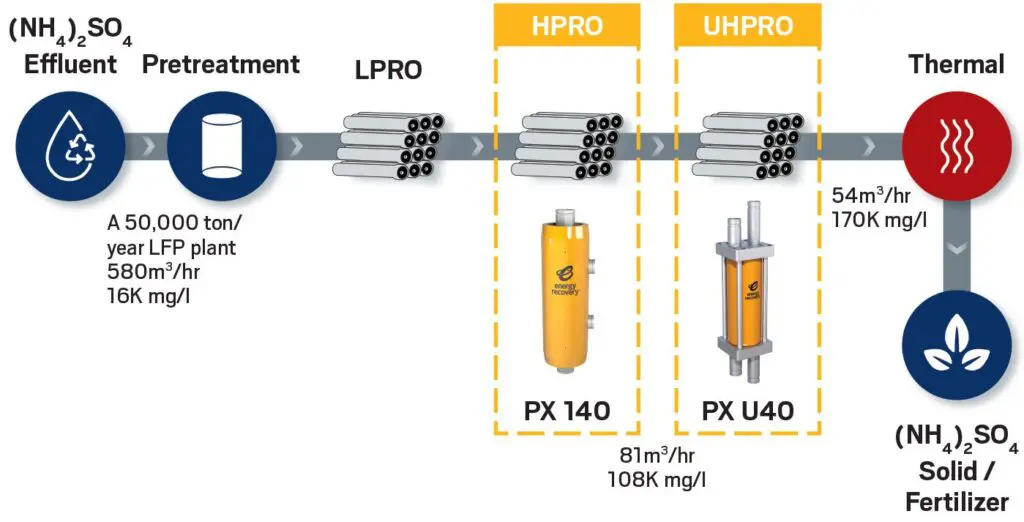
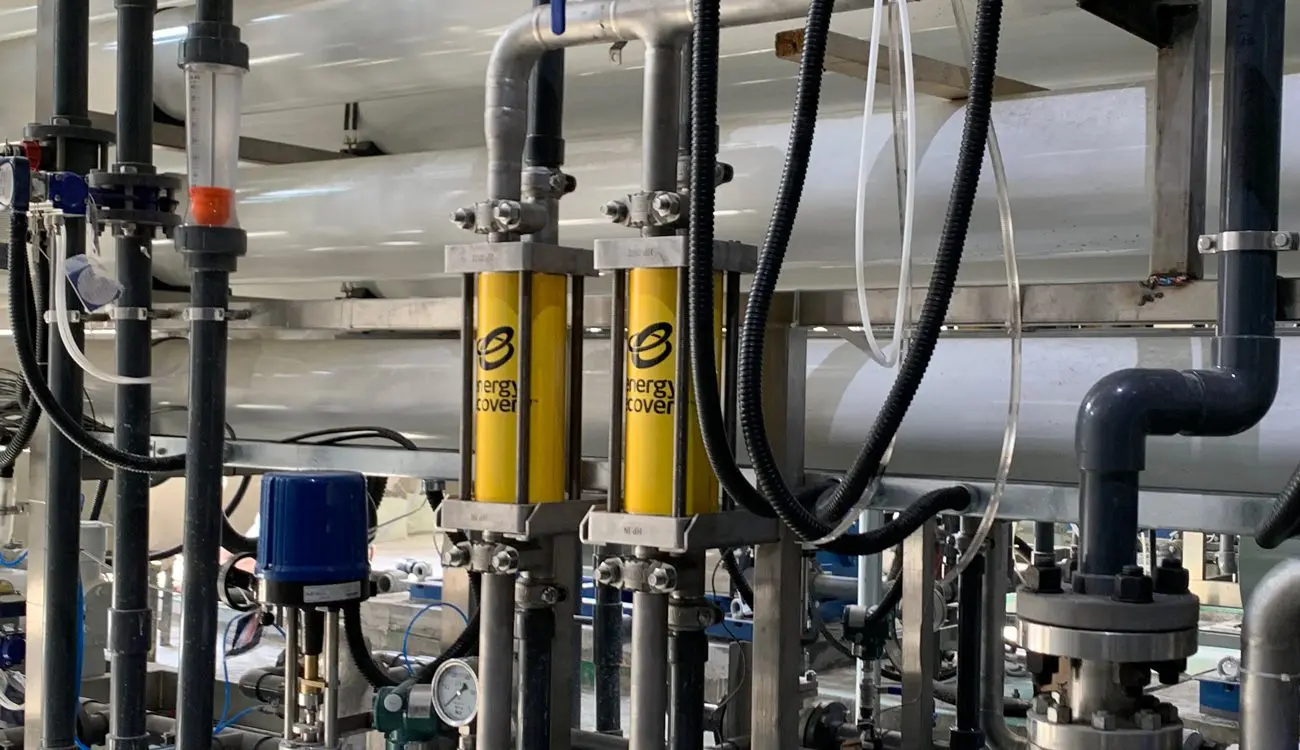
Sinochem chose the PX® Pressure Exchanger® for the second RO stage and the PX U40 (flow ranging from 4.5 to 9.1 m3/hr and specifically designed to operate in an ultra high-pressure environment) for the UHPRO stage to capture energy otherwise wasted in these high-pressure processes. The combination of these technologies significantly lowered overall energy consumption for waste treatment, allowing the site to drastically decrease both operating and capital expenses, and to dramatically reduce the investment in the thermal system. As an added benefit, treated freshwater is also now circulated back into the battery production facility, creating a closed water system that slashes water consumption and associated costs.
PX Operational Flexibility in LFP Cathode Manufacturing Waste Stream Treatment
The PX accommodates a wide operating range for flow and pressure
The waste stream parameters from a cathode manufacturing plant can vary considerably in terms of flow rate, TDS, and temperature, which will in turn lead to wide flow and pressure operating ranges for RO processes. The PX U40 can readily accommodate these changes while maintaining the highest performance and efficiency.
By integrating the PX and the PX U40 into our high-pressure and ultra high-pressure concentration process sections, energy consumption in the high-pressure and ultra high-pressure concentration process is reduced by about 51% and energy consumption across the entire wastewater treatment system is reduced by 4-5%. The result is a membrane concentration system that is more affordable and more energy efficient, thereby largely reducing the investment and operation expenses of the downstream evaporation crystallization system.
Mr. Liu GenTing, VP, Technical, Sinochem Membrane Technology
The Result
Cleaner Operations Without Higher Energy Consumption
This site was the first to commission an PX U40 in early 2022; therefore, rigorous site visits were conducted to confirm performance of the PX U40. While the facility has yet to ramp up to its full capacity, under real-world operating conditions, the PX achieved an efficiency of more than 95%, and the PX U40 an efficiency of more than 93%. With this savings, the payback for the equipment will be less than two years even at reduced feedwater levels of total dissolved solids (TDS). As the plant continues to increase TDS concentrations and system pressures, increased energy savings can be expected.