Overview
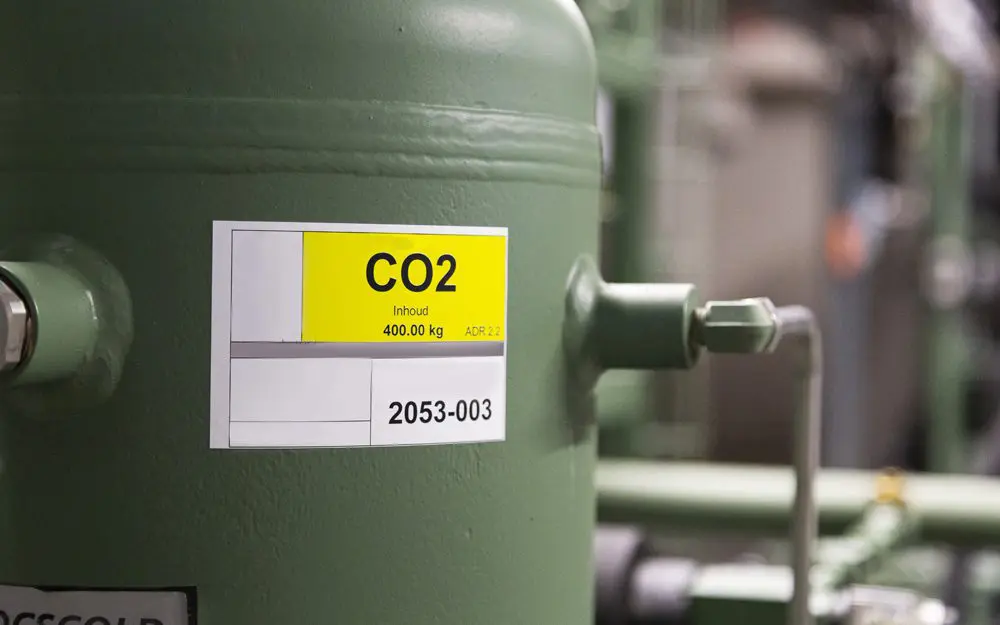
Learn how excessive flash gas can affect your CO2 transcritical booster system performance and how the pressure exchanger works to help solve it. To understand how the PX G1300 can help, we must first examine why these systems are prone to stress under extreme heat conditions.
Key Takeaway
The PX G1300 reduces the amount of flash gas generated during high ambient conditions to protect against multiple failure scenarios.
The Challenge
Transcritical CO₂ Systems in Heatwaves
Most CO2 systems are designed with 120 bar (1740 psi) pressure relief valves on the medium temperature (MT) compressor discharge. According to EN378 and ASHRAE 15, the high-pressure switches on the compressor discharge must be set between 108–110 bar (1566–1595 psi). This establishes a critical limitation for the system’s controls.
The control system, which regulates the gas cooler outlet pressure, must also account for the pressure drop across the gas cooler, oil separator, and piping to prevent the high-pressure switches from activating. This forces the control system to maintain the gas cooler outlet pressure within 95–105 bar (1377–1522 psi). Additionally, the high-pressure control system also regulates the receiver (flash tank) pressure, keeping it between 28–35 bar (400–500 psi).
Case Example
Heatwave with Ambient Temperatures of 43°C (110°F)
Consider a heatwave where the ambient temperature reaches 43°C (110°F), and assume the gas cooler is optimally designed with a 2°C approach temperature. This means the gas cooler outlet temperature is 45°C (113°F).
Under these conditions, the control system tries to maintain:
- Gas cooler pressure: 100-105 bar (1450-1522 psi).
- Receiver (flash tank) pressure: 35 bar (500 psi).
At this operating point, 58% to 64% of the refrigerant flow passing through the compressors is recycled flash gas, which cannot be used for cooling. This excessive flash gas can lead to multiple scenarios like:
- Flash Gas Bypass Valve Becoming Undersized:
- The bypass valve may fail to handle excessive flash gas, causing the flash tank pressure to increase. This forces the high-pressure valve to shut down to reduce the flash tank pressure, which in turn increases the compressor discharge pressure and triggers the MT high-pressure switches. Alternatively, high-pressure in the flash tank may trigger the pressure relief valve.
- Excessive Flow Rate at Compressor Discharge:
- High flow rates can exceed the design specifications, leading to significant pressure drops across the oil separator, piping, and gas cooler. These pressure drops may go undetected by the control system, resulting in MT high-pressure switch activation.
- Increased Compressor Power Demand:
- The higher refrigerant flow through the compressors increases power consumption, potentially tripping circuit breakers and causing compressor shutdown.
- Insufficient Liquid Refrigerant to Evaporators:
- A lack of liquid refrigerant reaching the evaporators reduces cooling capacity, leading to low suction pressure and activation of the compressors low pressure switches.
How the PX G1300 Mitigates Heatwave Stress by Reducing Flash Gas
The PX G1300 provides a simple yet effective solution by reducing the amount of flash gas generated during high ambient conditions. It achieves this by subcooling the gas cooler outlet using only the available high pressure in the system.
Field and laboratory experiments show that the PX G1300 can subcool the gas cooler outlet by 3.3°C (6°F). Returning to the earlier example, this subcooling reduces the flash gas amount from 64%-58% to 53%-50% a 17% to 14% reduction.
Why This Matters
This 17% to 14% reduction in flash gas can mean the difference between a functioning refrigeration system and one that fails under heatwave conditions.
In conclusion, the PX G1300 significantly enhances the reliability and resilience of transcritical CO2 booster systems during extreme heat events, ensuring uninterrupted cooling performance.