The Challenge

Scaling Industrial Water Reuse Sustainably in One of China’s Thirstiest Cities
Tangshan, a major industrial hub in northern China, is home to large-scale steel and chemical operations that drive high water demand. The city has become a leader in industrial water reuse within Hebei Province, a critical response to regional water scarcity and national mandates for sustainable development.
To meet growing industrial discharge volumes and increase treated water recovery, our customer, a leading public water company, expanded the capacity of the wastewater reuse plant in 2022. However, the expansion also triggered significant increases in energy consumption and operational expenditure (OPEX). Compounding this was the urgency to align with China’s carbon neutrality and peak carbon targets.
The reverse osmosis (RO) process, core to the plant’s water reuse operation, was identified as a major energy sink. To address this, the customer sought a proven solution to recover energy from the RO brine stream and lower the burden on the high-pressure pumps, while ensuring operational reliability and long-term sustainability.
Location
Tangshan, Hebei Province, China
Operator
A Leading Public Water Company
Plant Capacity
37,000m3/day*
PX Model
Low-Pressure PX
SEC
25% reduction**
Estimated Energy Savings
400,000 kWh/year
Estimated Cost Savings
$28,500 USD/year**
The Solution
PX Brings Efficiency and Reliability to Industrial Water Reuse
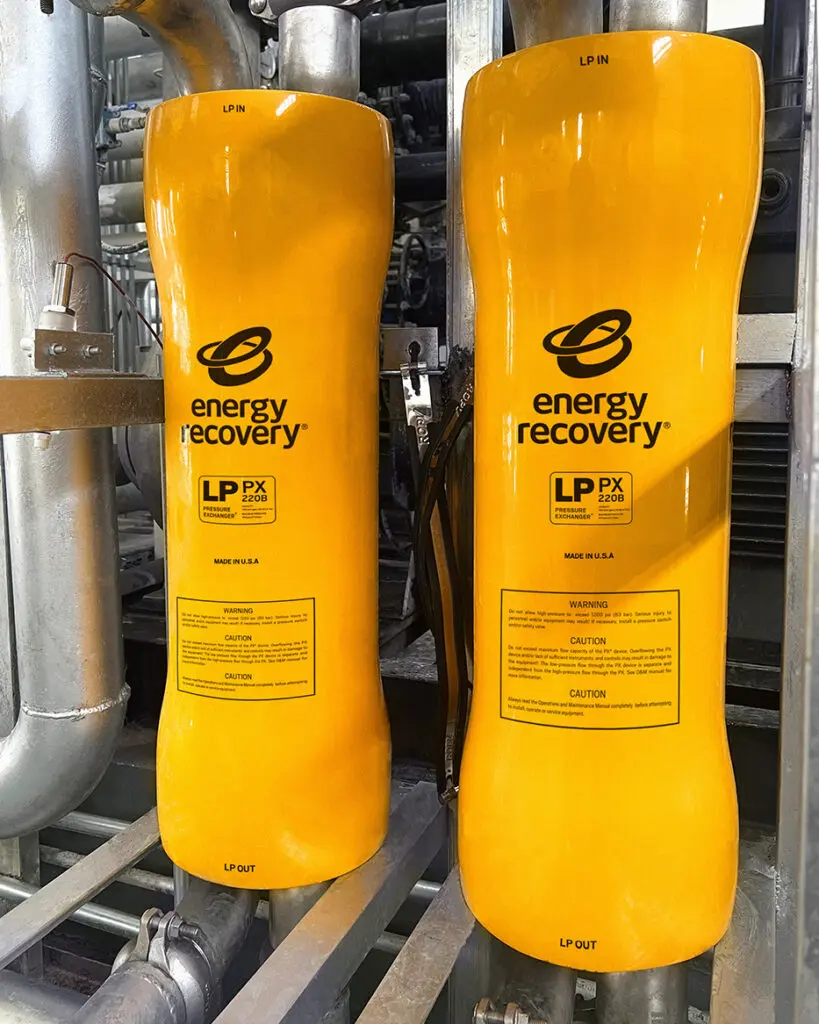
The customer selected two Low-Pressure PXs from Energy Recovery as a retrofit solution for one of its RO trains, marking a milestone installation for PX technology in industrial wastewater reuse. The system operates at low pressure, further underscoring the efficiency benefits of the LP PX units in this application.
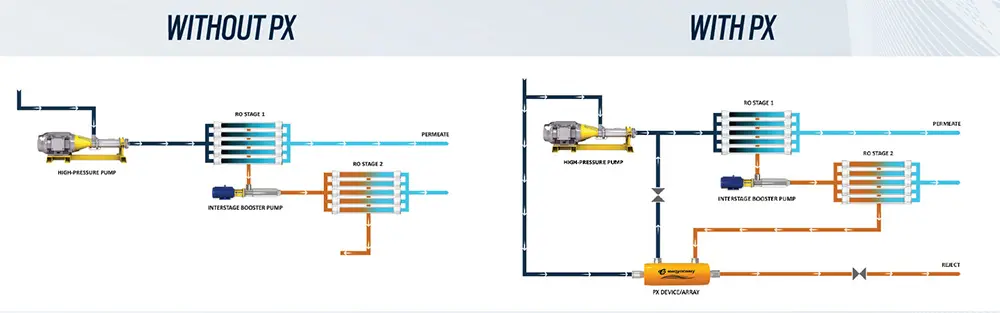
At approximately 70% system recovery, each RO train discharged around 80 m³/h of high-pressure brine. The PX devices recover this otherwise wasted energy and use it to pressurize incoming feedwater. This reduces the load on the high-pressure pump, which now only needs to pressurize the permeate flow. As a result, the high-pressure pump’s power consumption decreased by approximately 25% with lower operational speed.
The Energy Recovery technical team collaborated closely with plant engineers to develop and test a seamless automation strategy, enabling reliable, efficient, and hands-free operation of the PX system.
Why It Matters: A Model for Wastewater Treatment Around the World
This project represents a key milestone for the PX in industrial water reuse and a model for how energy recovery technologies can transform legacy infrastructure into climate-forward, economically viable assets. As industries around the world face increasing pressure to optimize water usage and minimize environmental footprints, the success at this wastewater reuse plant proves that PX technology is not only viable, but essential for the next generation of industrial water reuse systems.
RO membrane process energy consumption accounts for more than 60% of our reuse water plant. It is predicted that with an additional ~1% CAPEX investment in the Low-Pressure PX , it should cut nearly 25% of the RO process energy bill, which is ~15% of energy savings for the entire plant. In addition, we are happy with the flexibility and high efficiency of the Low-Pressure PX from the initial 3 months of operation.
Plant Operations Team
The Result
A Proven Pathway for Sustainable Industrial Water Reuse
The PX retrofit has delivered measurable energy and cost savings and proven its potential for broader deployment across the plant.
- Energy Consumption Reduction of over 25%
- Estimated Cost Savings: $28,500 USD/year
- Seamless Integration: Minimal disruption, fully automated control logic
- Annual CO2 avoided: 265 tons CO2
Beyond the immediate operational gains, this installation is helping our customer advance its leadership in circular industrial water management, while actively reducing energy use and associated carbon emissions. PX technology enables industrial users to turn water reuse from an environmental necessity into a high-efficiency, low-impact process.
*Plant Capacity = 37,000 m³/day; PX retrofit applied to 1 RO train = ~4,480 m³/day;
**Energy and SEC savings calculated from 1 RO train retrofitted with 2 LP PX at $.07 USD/kWh municipal power costs